Ken Scott started as an engineer at EMI Studios in 1964, where he worked under producer George Martin. In addition to many Beatles recordings, Scott engineered albums by Jeff Beck, Pink Floyd, and Procol Harum. In 1969 he moved to Trident Studios, where he engineered and/or produced albums by David Bowie, Elton John, George Harrison, the Mahavishnu Orchestra, and Billy Cobham, amongst others.
Encouraged by their soundman Russel Pope, Supertramp and A&M's Dave Margereson wanted Scott to produce Crime of the Century. But he wasn't impressed by the demos and wasn't, in his words, "the slightest bit interested." Margereson persisted, and ultimately A&M invited Scott to see Supertramp perform live, and that changed his mind. He not only liked what he heard, but saw plenty of creative opportunities and agreed to produce the record. He subsequently visited the band at Southcombe, where they were all living while working on the Crime of the Century songs.
Supertramp convened at London's Trident Studios in February 1974 with Scott at the console. A&M allowed Scott as much time as he needed, and as he wrote in his book Abbey Road to Ziggy Stardust, "Since we were going all out on this record, I decided that we should try to make it as different as we could." From the haunting notes of Rick Davies's wailing harmonica intro to "School," to its brief reprise at the album's finale, Scott drew upon his 10 years' studio experience to create a stunning work.
His first job, as always, was to get the drum sound, and it took over a day and a half to get it to where he was satisfied. "Ken completely transformed the sound of my drum kit," said Bob Siebenberg. "He transformed the whole sound of the band." In his quest for new and interesting sounds, Scott tried everything from playing wine glasses to a musical saw. He used a water-gong effect to introduce the dramatic closing section of the song "Crime of the Century." To achieve this, he had Bob strike a piece of sheet metal as it was lowered into an aquarium.
Instead of using stock sound effects from the studio library, Scott insisted on original material. For "School," he recorded children playing and screaming during the lunch break at his daughters' school. For the train-ride sequence in "Rudy," he dispatched Roger Hodgson and John Helliwell to Paddington Station to record ambient sounds and the station master's announcements. Coincidentally, one departure announcement mentioned stops at Didcot and Swindon, the hometowns of Roger and Rick, respectively. On leaving the station they recorded a busker playing violin, which became the link between the main part of "Rudy" and the quieter end section.
With Crime of the Century, Scott continued the meticulous way of mixing he had used since the Bowie albums, working only on a short section at a time. It took about a day and a half for each mix.
"We went completely overboard on everything, which is why the album took close to six months, a very long time for an album back then," Scott wrote. "Once we were given that crucial go-ahead from the label, we had no real choice but to strive for perfection."
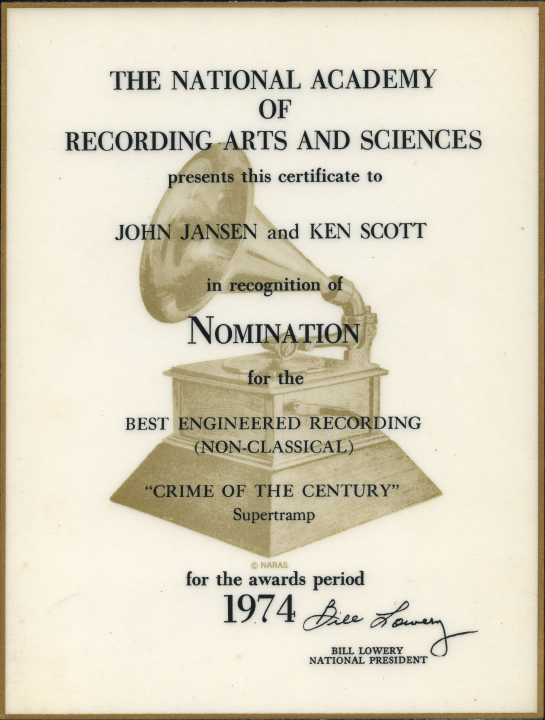
In 1974, Crime of the Century received a Grammy Award nomination for Best Engineered Recording (Non Classical).